Essays in Ancient and Modern Historiography by Arnaldo Momigliano
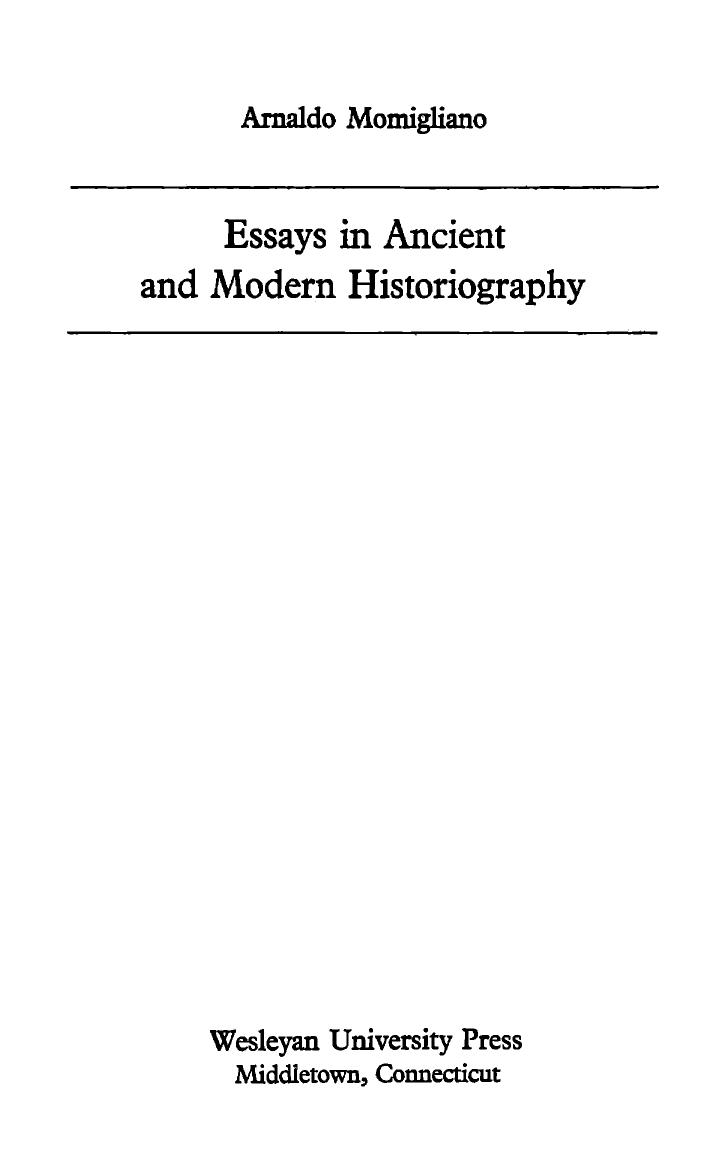
Author:Arnaldo Momigliano
Language: eng
Format: epub, pdf
ISBN: 9780226533865
Publisher: The University Of Chicago Press
* Journal of Roman Studies, 37, 1947, pp. 91–100.
* Journal of Roman Studies, 39, 1949, pp. 190–2. Cf. C. O. Brink, ibid., 41, 1951, pp. 32–51.
14
Perizonius, Niebuhr and the Character of Early Roman Tradition*
‘THE famous Ballad theory of Niebuhr of which we seldom hear now except in connection with Macaulay’s lays’ . . . 1 These are the words of Mr Last’s tutor–W. Warde Fowler. When he wrote them, in 1912, Warde Fowler was apparently not aware that the ballad theory had been revived a few years before by an Italian historian who was to exercise a deep influence on Mr Last.2 But the ballad theory involves other names–such as Perizonius, Vico, Niebuhr, Schwegler, Mommsen–which have been ever present in Mr Last’s mind and have often recurred in conversation. In more recent years the ballad theory has lost nothing of its prestige in Italy; two pupils of De Sanctis, A. Rostagni3 and L. Pareti,4 have made it the cornerstone of their interpretation of archaic Latin literature and historiography. Indeed, the theory has again found favour in England.5
A history of this theory has never been written, and therefore its implications have never been properly examined. One can even doubt whether the analysis of the ancient evidence (scanty as it is) has been exhausted. Each section of this paper can claim no more value than that of a hasty sketch of a large territory. But I hope that Mr Last will accept my discussion of a subject that he knows better than anybody else as part of that exchange of ideas between us which has now been going on for twenty-five years and to which I owe more than I can say.
I. THE HISTORY OF A THEORY
One of the consequences of the discovery of America was to confirm classical scholars in the belief that historiography began in poetry. Tacitus had written ‘Celebrant carminibus antiquis, quod unum apud illos memoriae et annalium genus est . . . ’ (Germ. 2, 3). Justus Lipsius commented ‘Uti apud barbaros fere omnes et rudes litterarum. Nec Hispani aliter comperere apud novos Indos’.6
At first sight the Romans seemed not to conform to this pattern. Their authors traced the origins of Latin historiography to the annals of the pontiffs: ‘erat historia nihil aliud nisi annalium confectio . . . ’. Yet a mistake in the interpretation of the grammarian Diomedes–resulting in an interpolation–provided unexpected inspiration. Diomedes had written: ‘epos Latinum primus digne scripsit is qui res Romanorum decem et octo complexus est libris qui et annales inscribuntur . . . vel Romanis’–and, of course, had meant Ennius.7 But his first modern editors thought that he was alluding to Livius Andronicus, and bravely put Livius into the text: ‘Epos Latine primus digne scripsit Livius is qui,’ etc.8 The combined authority of the interpolated Diomedes and of Justus Lipsius was decisive in persuading G. B. Vico that the Romans were no exception to what both the students of the ancient world and the explorers of the new world seemed to
Download
Essays in Ancient and Modern Historiography by Arnaldo Momigliano.pdf
This site does not store any files on its server. We only index and link to content provided by other sites. Please contact the content providers to delete copyright contents if any and email us, we'll remove relevant links or contents immediately.
| Africa | Americas |
| Arctic & Antarctica | Asia |
| Australia & Oceania | Europe |
| Middle East | Russia |
| United States | World |
| Ancient Civilizations | Military |
| Historical Study & Educational Resources |
The Daily Stoic by Holiday Ryan & Hanselman Stephen(3323)
The Fate of Rome: Climate, Disease, and the End of an Empire (The Princeton History of the Ancient World) by Kyle Harper(3067)
People of the Earth: An Introduction to World Prehistory by Dr. Brian Fagan & Nadia Durrani(2738)
Ancient Worlds by Michael Scott(2688)
Babylon's Ark by Lawrence Anthony(2679)
The Daily Stoic by Ryan Holiday & Stephen Hanselman(2578)
Foreign Devils on the Silk Road: The Search for the Lost Treasures of Central Asia by Peter Hopkirk(2465)
India's Ancient Past by R.S. Sharma(2454)
MOSES THE EGYPTIAN by Jan Assmann(2417)
The Complete Dead Sea Scrolls in English (7th Edition) (Penguin Classics) by Geza Vermes(2283)
The Earth Chronicles Handbook by Zecharia Sitchin(2230)
Lost Technologies of Ancient Egypt by Christopher Dunn(2226)
24 Hours in Ancient Rome by Philip Matyszak(2084)
Alexander the Great by Philip Freeman(2065)
Aztec by Gary Jennings(2032)
The Nine Waves of Creation by Carl Johan Calleman(1918)
Curse Tablets and Binding Spells from the Ancient World by Gager John G.;(1862)
Before Atlantis by Frank Joseph(1858)
Earthmare: The Lost Book of Wars by Cergat(1825)
